Events · 7/24/2026 · by Peter Ternström ·
The BRUTAL Corvette C8 E-Ray
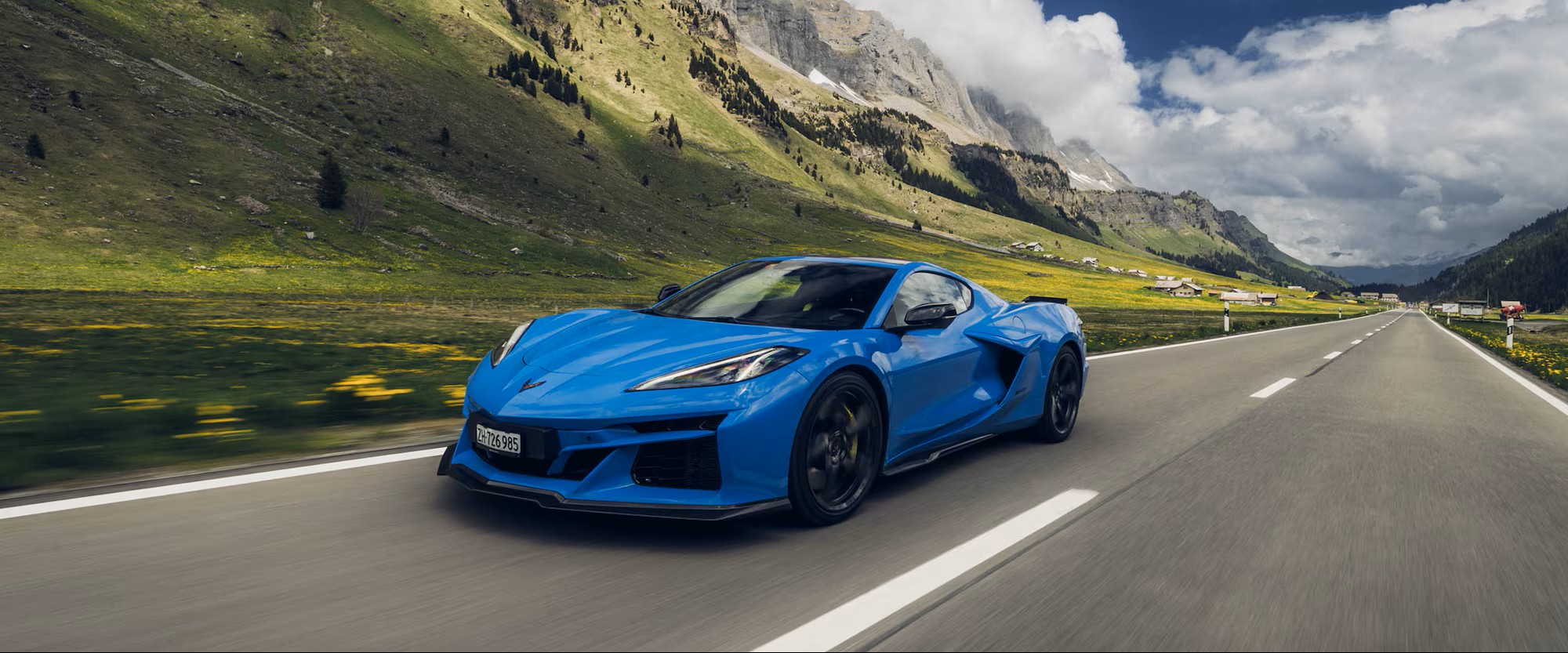
Peter Ternström’s review of the Corvette C8 E-Ray highlights a shift in American engineering. As the first AWD hybrid Corvette, it bridges the Stingray and Z06. The uniquely powerful, civilized supercar challenges European elites at a fraction of the price.
In Croatia and the Riviera, we had the opportunity to drive the C8 Stingray and the Z06. Both are great cars at a fantastic price point. The Stingray sits right in the ring with a base Porsche 911. At the same time, the Z06 basically invented a new class of naturally aspirated lunacy, punching up at the Ferrari 458 Italia without even breaking a sweat. On Gran Turismo Europa, we drove the third flavour: the hybrid Corvette. Based on the Stingray, the E-Ray adds an electric motor on the front axle. It’s the first four-wheel-drive Corvette ever made. A bit of heresy perhaps, but very effective heresy.
And it’s fast. Brutally fast. It actually accelerates harder than the Z06, which feels faintly ridiculous. The familiar 6.2-litre LT2 V8 remains proudly turbo-free, producing 481 hp on its own. But now it’s got a 162 hp electric motor helping at the front. Combined output: 643 hp. 0–100 km/h? 2.9 seconds. Quarter-mile? 10.6 seconds, crossing the line at roughly 206 km/h. This isn’t Corvette going hybrid. This is Corvette quietly installing a Star Trek warp drive. It is that fast. The acceleration is neck-stretching, even from a lazy roll at 20 km/h. Addictive, hilarious, slightly dangerous for your passengers. On the motorway, nothing catches you. Not even close. A tiny 1.1-kWh battery sits deep in the car’s spine, constantly recharging under braking — and during, let’s be honest, enthusiastic use. So basically all the time.
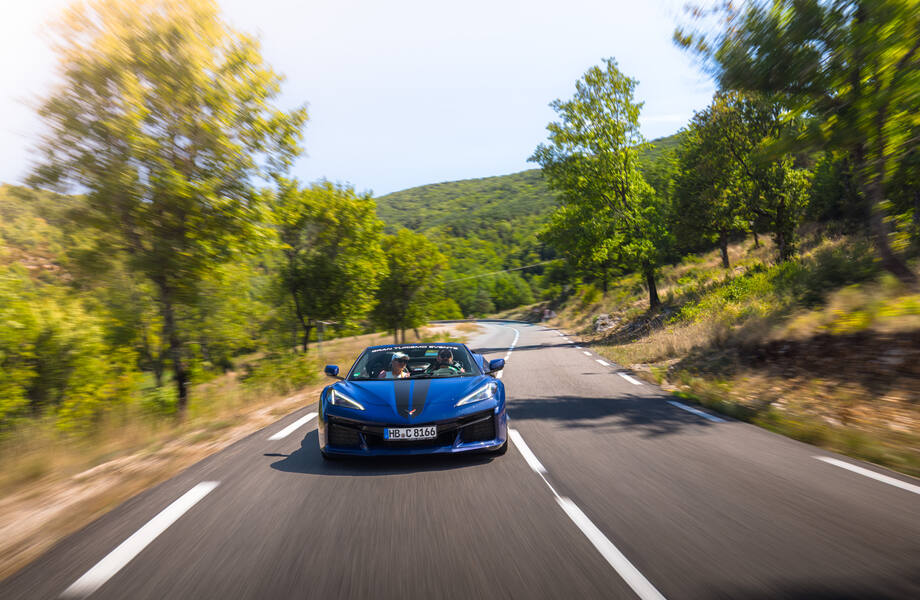
Behind the Wheel: How It Feels on the road In the driver’s seat, the first thing you notice is the effortlessness. Not the violence — that arrives later — but the calm. The E-Ray moves with the confidence of something that knows exactly what it can do and doesn’t feel the need to brag about it. Steering is clean, precise, and lets you place the nose exactly where you want it. Even on a narrow, bumpy road outside Siena, where most supercars feel slightly twitchy, the E-Ray settles in. The front electric motor doesn’t just add traction; it gives you this strange sense of being pulled into the corner. Almost cheating. Mid-corner balance is exceptional, very un-American, in the most flattering way possible. Push harder and the V8 wakes up properly. It fills the cabin with a mechanical growl that’s more “old-school thunder” than modern sound-designer nonsense. The hybrid system is clever enough that there’s zero lag, zero hesitation. You squeeze the throttle, and the car moves — instantly and continuously — the electric motor filling the tiny gaps between combustion pulses like torque-spackle. Ride quality is unexpectedly civilised. Even over rough surfaces, the magnetic dampers smooth out the worst bits. You always know you’re in something powerful, but it never beats you up. This is a supercar you could genuinely drive across Italy without climbing out with a stiff back and a quick list of regrets.
Grip? Immense. The tires give you the sort of traction usually found in winter rally cars or something with a prancing horse on the front and a terrifying maintenance schedule. It actually reminds me of the Huracán — the way it gives you confidence mid-corner is very similar. In the E-Ray, you suddenly feel like a racing driver. You brake too late, turn too sharply, accelerate too early… and the car just nods politely and gets on with it. And then there’s Stealth Mode. A gimmick, sure, but a charming one. The car glides away silently on electric power alone up to around 70 km/h. Perfect for slipping out of a Tuscan villa early in the morning without waking the entire valley. It feels slightly wrong, like driving a prototype you weren’t supposed to touch — which, in many ways, sums up the E-Ray experience nicely. Interior & Tech: Surprisingly Civilised Inside, the E-Ray continues the theme: proper supercar intent paired with daily-driver usability. You sit low, cocooned by a sweeping driver-centric cockpit. There’s leather everywhere, optional carbon-fibre trim, and that unmistakable central “rib” of switches — love it or hate it, you definitely don’t forget it. A crisp digital cluster, a sharp infotainment screen angled towards the driver, wireless CarPlay, a big head-up display, and a Bose sound system all make the car feel modern without trying too hard. There’s even a dedicated E-Ray menu showing torque flow, battery status and hybrid behaviour, which is geeky in exactly the right way. It’s surprisingly comfortable, easy to see out of, and you can drive it for hours without feeling like you’ve been interrogated by the suspension.
Verdict: Supercar Speed, Not Supercar Money So what’s the takeaway? The Corvette C8 E-Ray is a proper supercar — in acceleration, in grip, in the way it bends physics around corners — but without the financial drama that usually comes with this level of performance. A Ferrari 296 GTB? You’re looking at 330,000 EUR+ before you’ve even added the Italian-flag stitching, carbon roof, or the 16 obligatory “must-have” options. A Lamborghini Huracán Tecnica? 280,000–300,000 EUR depending on your carbon addiction. The Corvette E-Ray? In Europe, it starts around 175,000 EUR. Here’s the bit Ferrari and Lamborghini don’t want you to say out loud: in a straight line, the E-Ray will match or embarrass both of them. You get AWD, hybrid punch, staggering acceleration, and day-to-day usability that the Italians don’t offer unless the road is perfect. It’s not trying to replace a Ferrari or a Lamborghini — they still win on theatre, on noise, on that impossible Italian sense of occasion. But the E-Ray gives you 90% of the performance for half the money, with reliability that won’t require you to befriend your local mechanic on a first-name basis. The Corvette E-Ray is the supercar for people who actually enjoy driving more than posing — a missile priced like a sports car, delivering punches normally reserved for the aristocracy of speed.
Find the whole article here: Gran Tourismo